

 Español
  Deutsch
  Français
  Nederlands
  English
 Frequently asked questions about Rolltrailers
Q01: What is a rolltrailer and what is its primary function?
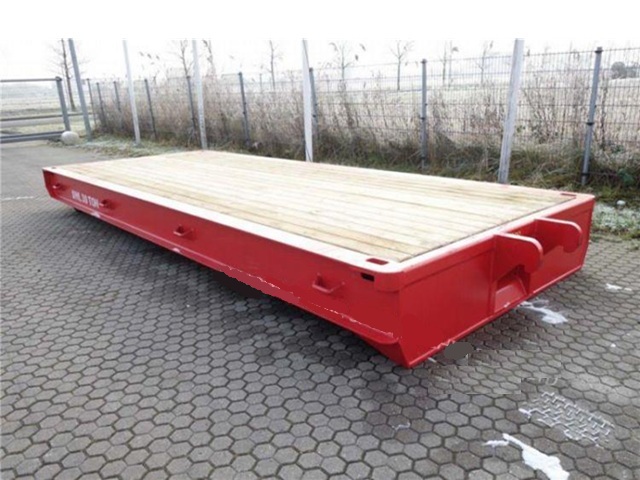
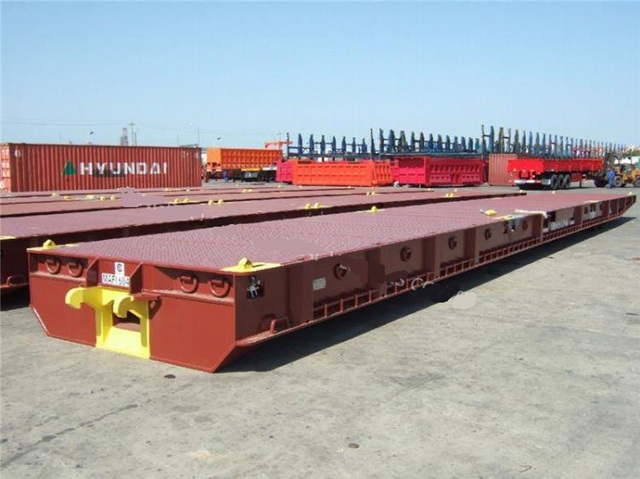
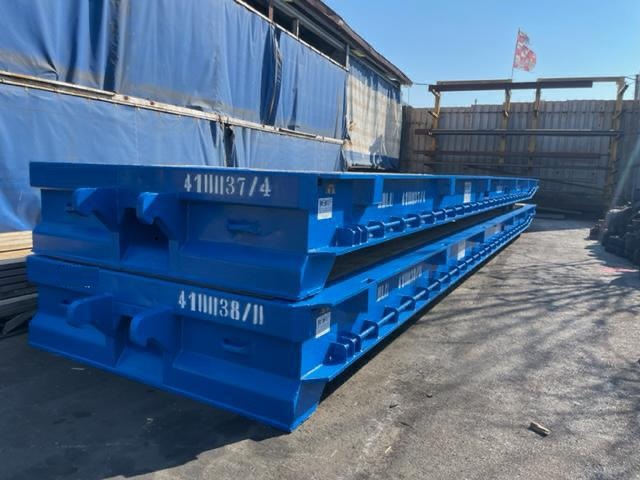
A01: A rolltrailer is a heavy-duty, unpowered flatbed trailer primarily used in port logistics and heavy industry for Roll-on/Roll-off (RoRo) transport and internal site transfer of containers, project cargo, and heavy machinery without relying on quay cranes.
Q02: How is a rolltrailer coupled and moved by a tractor?
A02: A rolltrailer features an open tunnel structure at the front into which a detachable or fixed gooseneck from a terminal tractor (tugmaster) is inserted and locked.
Q03: What are the most common length sizes for rolltrailers?
A03: The standard sizes are 20ft (approx. 6.1 m), 40ft (approx. 12.35 m), 45ft (approx. 13.7 m), and 62ft (approx. 18.9 m).
Q04: Why are rolltrailers equipped with solid rubber tires instead of pneumatic tires?
A04: Solid rubber tires are puncture-proof, extremely durable under heavy loads, require virtually no maintenance, and eliminate downtime caused by flat tires.
Q05: What is the function of the pendel axle system (rocker arms) on a rolltrailer?
A05: The pendel axle system distributes heavy wheel loads evenly across uneven surfaces, protecting both the trailer structure and the deck of the vessel or terminal from high point loads.
Q06: What is the typical payload capacity of a 20ft rolltrailer?
A06: A 20ft rolltrailer typically has a payload capacity ranging from 40 to 60 tons.
Q07: What is the standard platform width of 20ft and 40ft rolltrailers?
A07: The standard width is 2,500 mm, with options to extend to 2,600 mm or 2,800 mm for wider cargo.
Q08: What is the platform height of standard rolltrailers when unladen?
A08: The unladen platform height generally ranges between 700 mm and 850 mm, depending on the size of the trailer and its load capacity.
Q09: What is the payload capacity of a heavy-duty 62ft rolltrailer?
A09: A 62ft rolltrailer is suitable for heavy loads ranging from 80 tons to over 120 tons.
Q10: Which steel grade is typically used for the chassis of a heavy-duty rolltrailer?
A10: High-grade rolled steel such as S355 or Q345 is standard, with heavy IPE 550 beams applied for extremely heavy-duty models.
Q11: How many containers can a 40ft rolltrailer transport?
A11: A 40ft rolltrailer can transport either one 1 x 40ft ISO container or two 2 x 20ft ISO containers.
Q12: Which container combinations can be loaded on a 62ft rolltrailer?
A12: A 62ft rolltrailer is suitable for various combinations, such as 3 x 20ft, 1 x 20ft + 1 x 40ft, or 2 x 30ft containers.
Q13: How are containers secured on a rolltrailer platform?
A13: Containers are secured using flush-mounted corner castings or twistlock pockets integrated directly into the deck frame.
Q14: How is non-containerized heavy cargo secured on a rolltrailer?
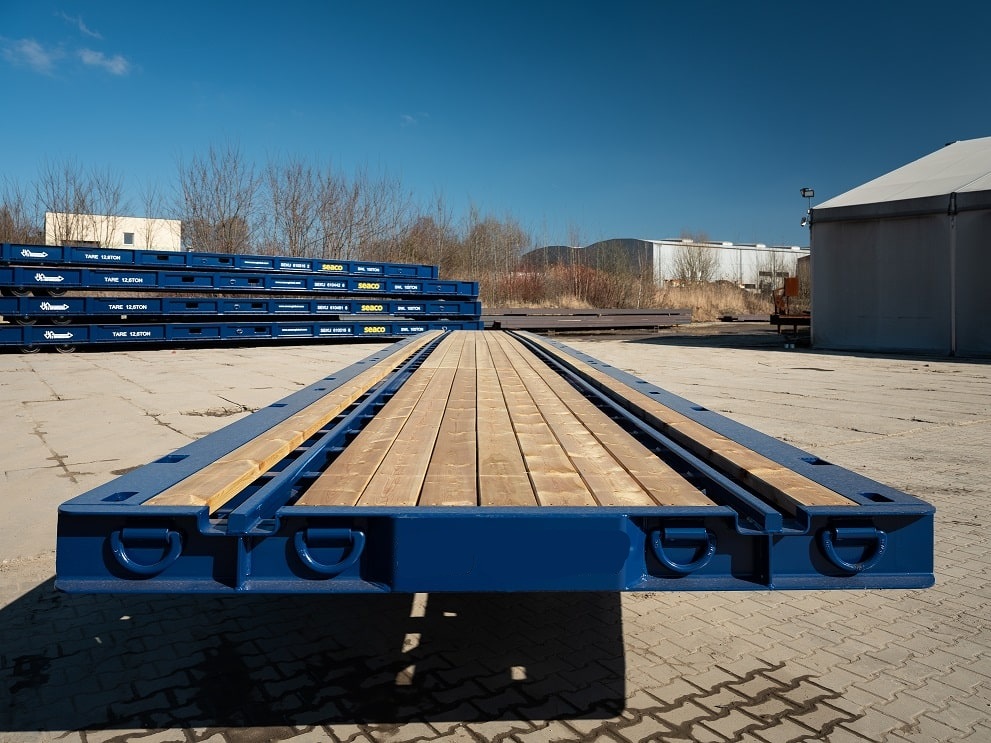
A14: Heavy cargo is secured using heavy-duty D-rings or lashing points on the side frame, with a minimum breaking load (MBL) of up to 36 tons per point.
Q15: Can empty rolltrailers be moved using a forklift?
A15: Yes, many models are equipped with integrated side forklift pockets, specifically designed for moving empty trailers with a heavy forklift.
Q16: Which deck materials are commonly used for rolltrailers?
A16: Decks are usually finished with impregnated pine, durable hardwood (approx. 45–55 mm thick), steel checker plate, or they are configured as an open skeleton frame for container handling.
Q17: What special option can be built onto the deck of a 62ft rolltrailer for rail transport?
A17: The deck can be equipped with integrated rail tracks (e.g., track gauge 1,435 mm or 1,535 mm) for direct transfer and transport of railcars.
Q18: What is the advantage of a rolltrailer with an open skeleton frame?
A18: It reduces the tare weight of the trailer and provides a lightweight, efficient solution purely optimized for transporting ISO containers.
Q19: How many axles and wheels does a heavy-duty 62ft rolltrailer have on average?
A19: A 62ft rolltrailer typically has 4 to 6 pendel axles with a total of 8 to 12 solid rubber wheels.
Q20: What type of bearings is used in rolltrailer axles to support extreme weights?
A20: Heavy-duty double-tapered roller bearings mounted in solid or thick-walled box section axles.
Q21: In which industrial sectors outside of ports are rolltrailers frequently used?
A21: They are widely used in steel mills, foundries, crane manufacturing, and heavy equipment manufacturing for transporting raw materials, molds, and large structural components.
Q22: What is the primary maintenance advantage of a rolltrailer compared to a road-configured semi-trailer?
A22: Rolltrailers feature a simple, mechanically extremely robust construction without complex pneumatic brake systems or inflatable tires, keeping maintenance costs and downtime to a minimum.
Q23: What coupling load can the gooseneck tunnel of a heavy-duty 62ft rolltrailer withstand?
A23: The reinforced gooseneck tunnels are fitted with wear plates capable of withstanding coupling loads exceeding 45 tons.
Q24: What is the main operational advantage of using rolltrailers in RoRo shipping?
A24: It allows cargo to be driven on and off quickly via vessel ramps without requiring quay crane capacity.
Q25: Who are the most well-known manufacturers of commercial and industrial rolltrailers?
A25: Well-known manufacturers include MAFI, Seacom (Swecom), Houcon, and Novatech.